Blueberry Funded in numbers, not adjectives
Most prop firm reviews are written from the sales page. This one is written from the rules, because the rules are what decide whether an evaluation is winnable. Everything below was taken from Blueberry Funded’s published challenge comparison, and the arithmetic is ours.
The pitch is that Blueberry is a broker-backed firm: trades are routed through a broker rather than simulated in a vacuum, spreads start from 0.0, and there is no time limit on the evaluation. Whether that matters to you depends on your style, but it does change one thing that matters a lot to scalpers: slippage and spread behaviour on live conditions rather than a padded feed.
Disclosure: we earn a commission if you buy through the links on this page, at no extra cost to you. It never changes the numbers below, and every figure here was copied from the firm’s own published terms.
The three challenge models, side by side
Blueberry runs three distinct products, and they are not variations of the same thing. The drawdown and the profit split move in opposite directions, which is the whole decision.
| Flex 1-Step | Prime 2-Step (Elite) | 1-Step | |
|---|---|---|---|
| Profit target | 12% | 8% then 6% | 10% |
| Max drawdown | 12% | 10% | 6% |
| Daily drawdown | 3% | 4% | 4% |
| Consistency rule | None | None | None |
| Minimum days | None | 3 days per phase | 3 days per phase |
| Profit split | 85% | 80% | 80% |
| Max risk per trade idea | 1% | None published | 1.5% (funded) |
| Payout cadence | Bi-weekly | Bi-weekly | Bi-weekly / on demand |
Read that table as three different trades you are making with your evaluation fee:
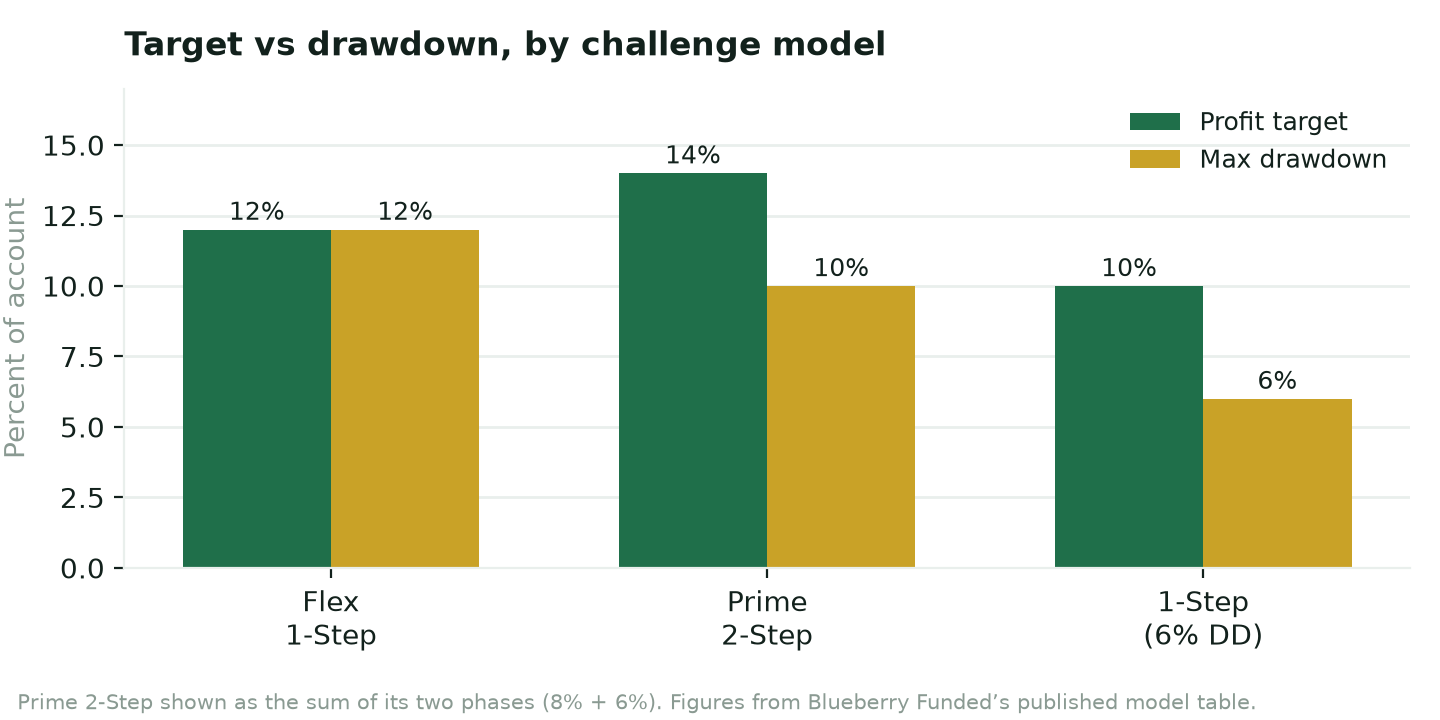
- Flex 1-Step buys you the widest drawdown (12%) and the highest split (85%) for the same 12% target. It is the most forgiving of the three on paper, and it is the one that suits a swing trader who needs room to be wrong for a few days.
- Prime 2-Step needs two phases but each is smaller (8% then 6%) and the drawdown is tighter at 10%. Two phases means two chances to fail, which is why the advertised split is lower.
- 1-Step has the tightest drawdown at 6% against a 10% target. That ratio, 1.67:1 target to drawdown, is the hardest on the board. It exists because some traders prefer one phase over two, and they pay for that preference in risk.
The thing that is not on that table anywhere is a consistency rule, and that is worth pausing on. Many firms now cap your best day at 30% or 40% of total profit, which quietly invalidates a strategy that makes its money in two big sessions. All three Blueberry models list consistency as none. If you trade news or trade infrequently, that clause is worth more to you than a higher headline split.
What the drawdowns mean in rands and cents
Percentages are abstract until you convert them. On a $100,000 account:
| Model | Max drawdown | In dollars | Daily drawdown | Daily budget |
|---|---|---|---|---|
| Flex 1-Step | 12% | $12,000 | 3% | $3,000 |
| Prime 2-Step | 10% | $10,000 | 4% | $4,000 |
| 1-Step | 6% | $6,000 | 4% | $4,000 |
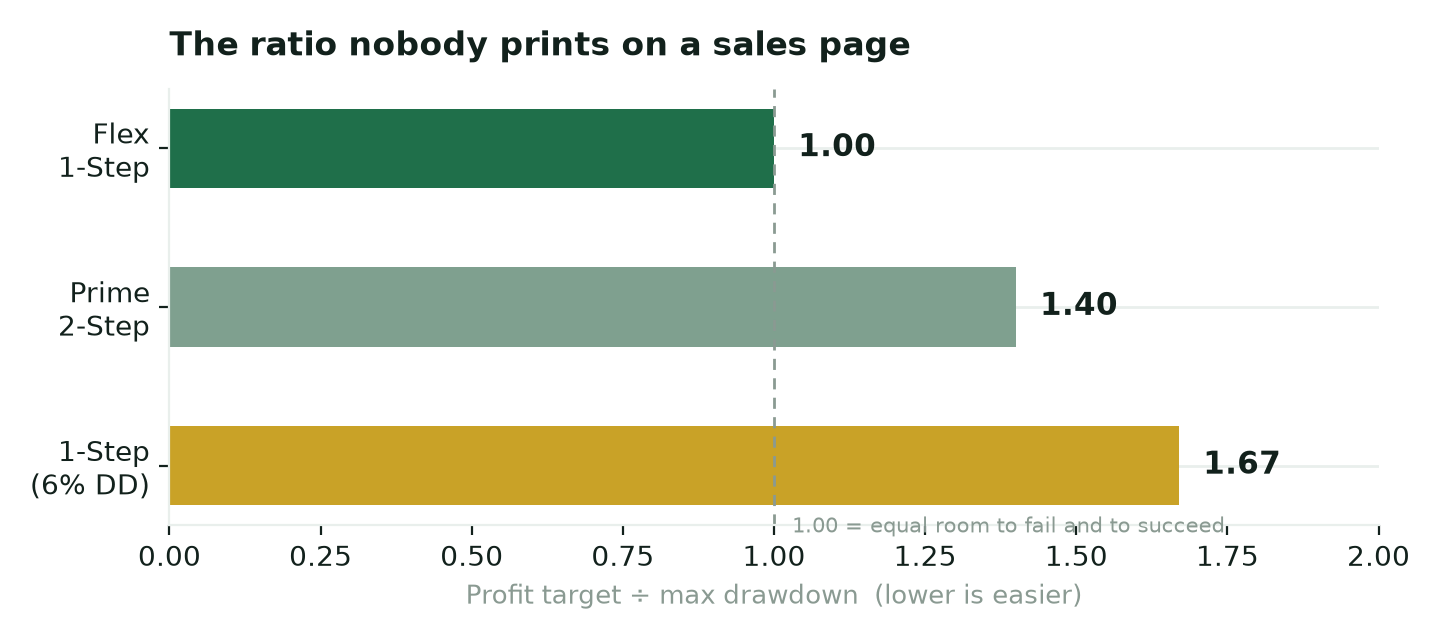
Now the part traders skip: the target to drawdown ratio. Flex needs 12% of profit with 12% of room, a ratio of 1.00. Prime needs 8% with 10% of room, but twice, so the two-phase effective ratio is closer to 1.4. The 1-Step needs 10% with 6% of room, a ratio of 1.67. The lower the ratio, the more combinations of trades can get you there.
That is the single most useful number on this page, and no sales page prints it. Run your own numbers through the profit target calculator and the drawdown calculator before you compare fees, because a cheap evaluation with a 1.67 ratio is more expensive per funded account than an expensive one at 1.00.
Challenge rules change more often than any review can follow. Verify the current drawdown, target and split on Blueberry Funded’s own pricing page before you enter, and use the calculators below to check that the numbers fit your risk.
The evaluation fee is not the cost of the account
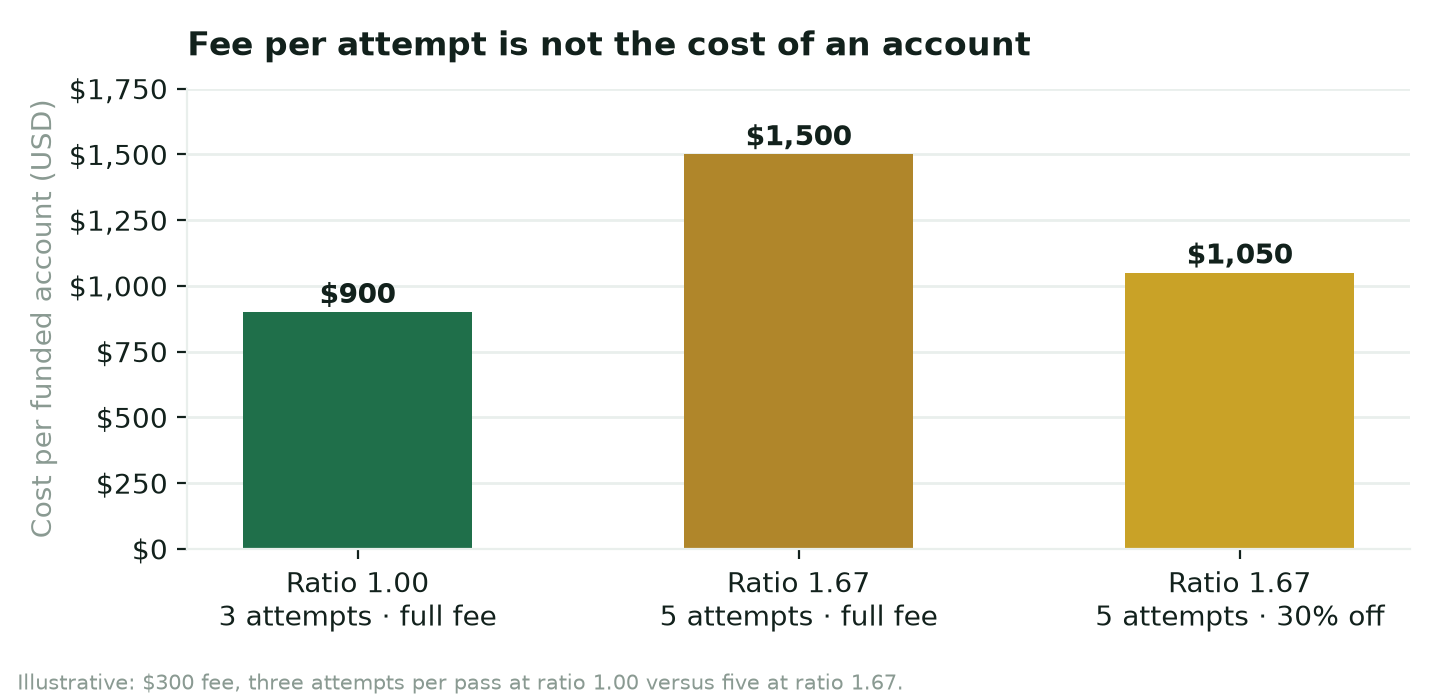
A $343 fee sounds like the price of a funded account. It is the price of one attempt. The real cost is the fee divided by your probability of passing, and that probability is set by the ratio above and by how you size.
Worked example. Suppose a trader passes one attempt in three on a model with a 1.00 target-to-drawdown ratio, and one in five on a model with a 1.67 ratio. At $300 an attempt:
| Model | Fee | Attempts per pass | True cost per funded account |
|---|---|---|---|
| Ratio 1.00 | $300 | 3 | $900 |
| Ratio 1.67 | $300 | 5 | $1,500 |
| Ratio 1.67 with a discount code | $210 | 5 | $1,050 |
The discount closes part of the gap and none of the difficulty. A 30% code on the harder model still leaves you paying more per funded account than full price on the easier one. Buy the ratio first, the discount second.
Blueberry was running two codes at the time of writing: PRIME30 for the Prime challenge and FLEX30 for the Flex challenge, both advertised as 30% off. Codes rotate, so check the banner on their site rather than trusting this page.
Where the money actually arrives
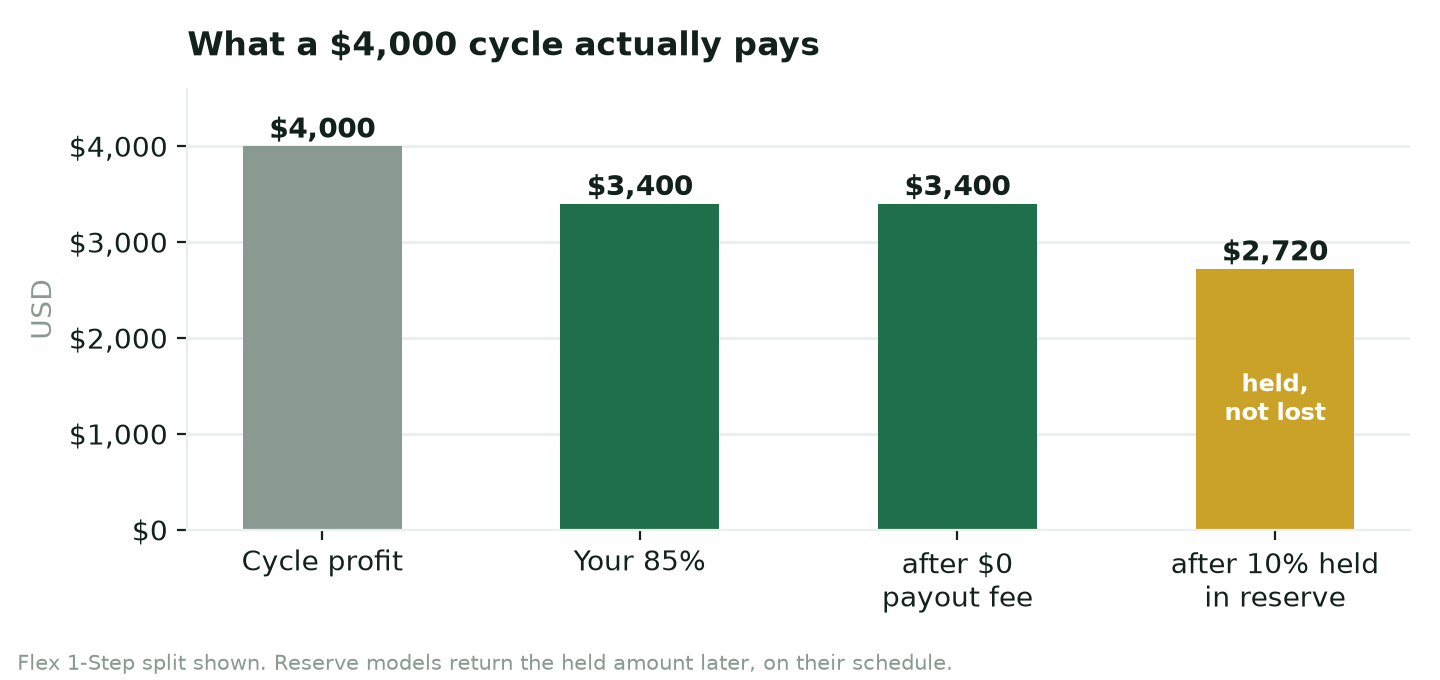
A split percentage is a headline figure. What reaches your bank account is split, minus payout fees, minus anything held in reserve, and it arrives on the firm’s cycle rather than yours.
Blueberry advertises payouts in under 24 hours with a bi-weekly cycle and on-demand requests, and states that it has paid out over $9 million across 50,000+ active traders. Those are the firm’s own claims; the number you should test for yourself is smaller and more concrete: your first payout, how many days after request it lands, and whether the amount matched the split you were quoted.
Do that calculation on your own cycle with the profit split calculator. If the split is 85% on a $4,000 cycle, you are expecting $3,400. If $3,100 lands, the missing $300 is a payout fee or a reserve, and now you know what that clause costs per cycle rather than per year.
The honest arguments against
No review is a recommendation list without a downside section, so here is the one that matters.
- No published consistency rule cuts both ways. It is good for you, but it also means the firm relies on drawdown rather than profit-pattern checks, and firms that lean on drawdown tend to enforce it to the cent.
- Bi-weekly is not instant. If the whole point of prop trading for you is being paid this week, an on-demand model at a lower split may serve you better.
- Broker-backed is a claim about routing, not a guarantee about regulation. Ask their support in writing who holds client funds and which entity you are contracting with. Any firm that cannot answer that plainly is a pass, regardless of its drawdown.
- Prices move. The fee table on their site changes with sales and account size. Verify it on the day you buy.
Who it fits
The Flex 1-Step suits a trader who needs 12% of room and takes few, larger decisions, which describes most discretionary traders who survive prop evaluations. The Prime 2-Step suits someone who wants two attempts at a smaller target and does not mind the time. The 1-Step with 6% drawdown suits a scalper who runs tight stops and takes many small trades, and it will ruin a swing trader inside a month.
That is the honest summary: the models are priced sensibly by difficulty, and the choice between them is a statement about your strategy rather than a statement about which one has the better discount code.
Frequently asked
Is Blueberry Funded legit?
It publishes its rules, runs a broker-backed model, and states over $9 million in payouts. That is more disclosure than most. Legitimacy in this industry is verified by a first payout, so treat your first funded cycle as the test and withdraw as soon as you are eligible rather than letting a balance sit.
What is the profit split?
85% on the Flex 1-Step and 80% on the Prime 2-Step and 1-Step models, paid on the bi-weekly cycle.
Are there consistency rules?
None listed across the three models. Verify this on the challenge page at the time you buy, because it is the clause firms change most often.
Which model is easiest to pass?
By the target to drawdown ratio, the Flex 1-Step at 1.00. It also has the widest maximum drawdown and the highest split. The trade-off is the 12% target, which is larger than the 2-step alternatives.
Can I use an EA or trade synthetics?
Blueberry publishes an automated-trading policy and offers 24/7 synthetic indices. Read the automation clause before deploying an EA: rules on copy trading, HFT and latency arbitrage vary by firm and breach accounts quietly.
Challenge rules change more often than any review can follow. Verify the current drawdown, target and split on Blueberry Funded’s own pricing page before you enter, and use the calculators below to check that the numbers fit your risk.
If you are still choosing between firms rather than between models, start with how to compare prop firms, then check your risk per trade with the position size calculator.
We build and repair trading robots (MT4/MT5, MQL5) for a fixed price on Fiverr: view our MQL5 development services.
Written by Justice Manyika — trading systems builder, Johannesburg. Educational content only, not financial advice. See our disclaimer.